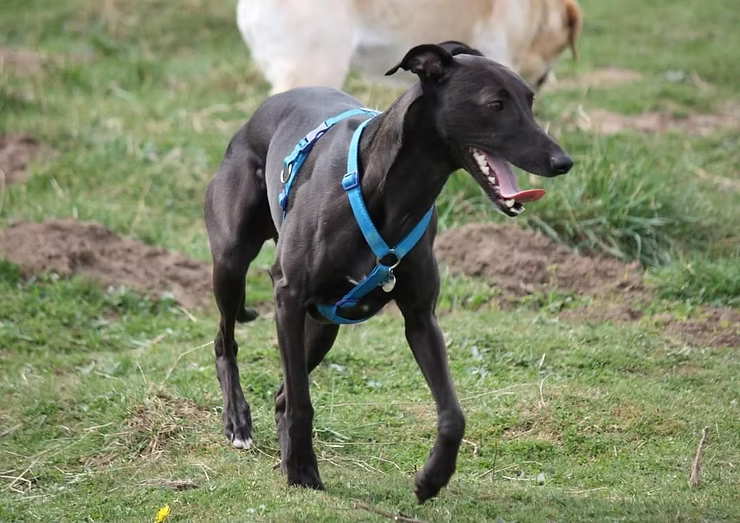

Mistake To Avoid When Training Your Whippet Puppy
Mistakes To Avoid With Your New Puppy
Getting a puppy should feel exciting, joyful and a little bit chaotic — not confusing, guilt-inducing or overwhelming. But with the amount of outdated advice still floating around online, it’s no wonder new puppy owners end up second-guessing every decision.
A quick Google search and suddenly you’re being overwhelmed with a barrage of different advice about what to do with your puppy, much of which simply contradicts each other. Your puppy then gets confused by your ever changing approaches to training and raising based on those google searches.
There is so much outdated information out there that will set your puppy up for failure and set you up for big challenges later on. Here are some of the most common mistakes new puppy owners make — not because they’re doing anything “wrong”, but because the advice they’ve been given simply isn’t helpful for modern dog training or puppy wellbeing.
Mistake 1: Leaving Your Puppy to “Cry It Out”

This is one of those old-school pieces of advice that really needs to disappear. The idea that a puppy should “just get used to being alone” by crying themselves to sleep isn’t fair, kind, or effective. It often creates MORE problems, not less.
A puppy who’s left to cry it out learns one of two things:
1. Nobody comes when I’m scared, or
2. My crate is a horrible place.
Neither helps you build a secure, confident adult dog. Your puppy may eventually quiet initially, but over time it often resurfaces because you have never actually taught them to be ok, you simply ignored them having a panic attack. Ignoring an anxious puppy creates anxiety issues later as well as causing insecurity.
Sleeping near your puppy at first, whether that’s a crate next to your bed, you on the sofa, or a mattress on the floor helps them form a secure attachment. And puppies with secure attachments are far less likely to struggle with separation anxiety later in life. Don't listen to folk saying your “spoiling” them by being close, this is not true you are helping them feel safe. After all, they have been separated from everything they knew their whole life, their mum and littermates and breeder and family. They need security and consistency early on.
Mistake 2: Keeping Them Indoors Until They’re Fully Vaccinated

This one causes so many problems, simply because owners are trying to do the right thing. You want to keep your puppy safe… but keeping them hidden away until 12–16 weeks / after being fully vaccinated is actually far riskier when it comes to behaviour. Obviously you need to be aware of risk, and different countries and different local areas will have different levels of risk for infections. However going outside doesn't need to mean contact with the floor and shouldn't necessarily mean contact with other dogs.
However you have a very small window for early socialisation. If that window closes before your puppy meets the world, they can become fearful, anxious or overwhelmed later in life. Simply because they had no exposure when they are more able to process new situations, sights and sounds. Once that socialisation window ends, your dog will be naturally more cautious about new things. Which is not ideal for our sensitive sighthounds at all.
Being safe doesn’t mean being isolated.
You can absolutely take your puppy out before full vaccinations, just carefully.
Options include:
-carried in your arms
-trips out in a sling
-sitting in the car with the boot open
-watching the world from your lap
- Meeting dogs of family or friends who are puppy friendly and you know are vaccinated and healthy
gently exploring different sounds, sights and people from a safe distance
Exposure doesn’t mean touching everything. It means experiencing the world in a gentle, controlled way. Try and make sure your puppy gets out and sees the world beyond your house and garden, just do it in a safe way. This will help prevent reactivity later.
Mistake 3: Waiting for Classes Before You Start Training

Group classes are brilliant for puppy training and exposure to being around distractions but they’re not where puppy training begins. Training starts the second your puppy comes home, and at this stage it’s all about fun, connection and confidence building. Creating a bond with tasty treats teaching foundation skills.
You don’t need equipment, or a hall full of other dogs, or anything fancy. You just need to start small:
teaching your puppy that you’re worth paying attention to
rewarding calm moments
playing gentle training games
showing them how to navigate their new world
If you wait until your first class, you’ve missed weeks of foundation learning — and those first weeks are where your puppy is a little sponge soaking up everything they can. In fact if you wait until your first puppy class, don't be surprised if your pup doesn't pay any attention to you in a room full of new sights and sounds!
Mistake 4: Only Calling a Trainer Once Things Go Wrong

So many behaviour problems could be prevented with early support. Puppies don’t come with instruction manuals although that would certainly be easier! It’s completely normal to struggle with biting, toilet training, overstimulation, night waking, or the “why is my puppy doing the opposite of what I want?” stage.
Working with a trainer from the start isn’t admitting defeat, its not something you do when things are starting to go horribly wrong and it doesn't mean your a failure, it’s giving yourself and your puppy the best chance of success.
Puppies who get early guidance are far less likely to develop serious behaviour issues later. You don’t need to wait until you’re at breaking point. Getting support early simply means you get answers sooner, avoid common pitfalls, and learn how to guide your puppy through all the tricky developmental phases.
Working with a trainer from day 1 is actually more likely to setup you with the skills to read your puppy, guide them and teach the right skills for you and your pups life, this is why we offer online zoom consults to owners anywhere in the world. https://whippetwonders.co.uk/puppy-training
Mistake 5: Focusing on Obedience Instead of Life Skills

There’s a huge difference between raising a well-rounded puppy and raising a “perfect” puppy — and chasing perfection usually leads to stress for both of you. And always remember, perfect doesn't actually exist. Anyone who says it does, is lying!
Obedience has its place, but your puppy’s early months should be about:
learning how the world works
playing
exploring safely
practising calmness and learning to settle
meeting appropriate people and dogs
building resilience and confidence
A puppy who can cope with the world is far more valuable than one who can perform a flawless sit but panics the moment something unexpected happens.
Focus on life skills, not military precision.
Raising a Puppy Doesn’t Have to Be Overwhelming
You’re not supposed to know everything. And you’re definitely not failing if you recognise some of these mistakes, when you know better you can do better. You can only do the things you are aware of.
With the right guidance, raising a puppy can feel joyful, connected and manageable. And if you’d like support in those early months, whether you’re dealing with nipping, over-arousal, sleep, socialisation or just feeling a bit lost, I’m here to help.
You can learn more or book a puppy session through my website. Let’s make this stage easier for both of you. https://whippetwonders.co.uk/puppy-training